There's an important lesson that anyone interested in art and entertainment needs to keep close to their hearts: beware of anything that has an abnormally long production time. If something's been in the work for, say, a decade or more, there's a natural tendency to build it up to build it up to such an unrealistic level that disappointment is inevitable. It also doesn't help that these things, for some reason, tend to be objectively disappointing across the board. The examples are endless, and span virtually all modern media. In movies, The Phantom Menace was anticipated for years and years, and look at how great that turned out. In music, Guns N' Roses promised us Chinese Democracy in the '90s, and when it finally came out in 2008, nobody wanted it, not even Best Buy bargain shoppers.
STOP GIVING AXL ROSE MONEY, FOR THE FUCK'S SAKE
In video games, the most obvious example is Duke Nukem Forever, a game that honestly deserves its own series of blog entries. But The Last Guardian certainly should be included among that crowd. Originally created by Team Ico in 2007, the game suffered delay after delay after delay, with many, including myself, thinking it was never going to be released at all. Well, imagine my surprise when, in 2015, we were finally given a release date, and in late 2016, the game came out for the PS4. After playing through a good portion of the game, the question must be: was this game worth the nearly ten year wait we as gamers were subjected to?
Like all of Team Ico's games, I can sum up the point in a few sentences. You're a young boy, and you wake up in a field next to a giant beast named Trico, which, I have to say, is probably the best part of the game. Trico's design is so fucking adorable.
I mean, come on - look at that little face. Don't you want a plush of this guy?
Anyway, I'm distracting myself. You and him are essentially set on exploring this ruined world, a world that's filled with colossal broken towers, demonic suits of armor, and titanic cliffs. Like Team Ico's other two games, the plot and characterization is minimal, with story progression often given through suggestion and, on occasion, brief flashbacks. What's important, instead, is atmosphere, and the intense focus, through the gameplay, of the relationship between you and Trico.
I opened this blog by asking whether this game was worth waiting almost a decade for. I now think that question is irrelevant - instead, we should be asking, was it worth paying $60 for? The answer to that question is much easier: no.
The Last Guardian is simply too short to justify that price - if played correctly, the game can be beaten in a matter of hours. This is a criticism I had of both Ico an Shadow of the Colossus, and such criticism is harder to accept, in 2017, than it was in the mid 2000s. When I play The Last Guardian, it feels, now, like a game that would be offered exclusively on the Playstation Network and sold for $15 or $20. Something like Journey, for instance. Such a price would, I think, be fair - you can be taken in by the astonishing setting, the powerful relationship between your character and Trico, and be done with it quickly.
As it stands, we're asked to pay the same price for this game as we are for, say, Final Fantasy XV, a game I'll bring up again since it seems to be a reoccuring theme of this blog. I've probably put in close to 50 hours in that game, and I still am not anywhere near close to finishing all that it can offer. I paid full price for that game, and I feel that price was justified for such a massive game. The Last Guardian has no justification.
This all sounds pretty negative, and I suppose it is, but honestly I really like the game as a whole. Trico is actually surprisingly responsive to commands, which I wasn't expecting for a computer AI character. The settings, as I've said, are gorgeous, and Team Ico stands second to none when it comes to creating mood in their games. There is an overwhelming sense of loneliness in their worlds - though there are, technically, other people, the games make you believe that you and your companion are the only living things left. What each game does with that feeling is different - Ico makes you feel like a protector, while Shadow gives you an intense feeling of sadness when you're done killing all those colossi. The Last Guardian, in purely tonal terms, is my personal favorite - the cooperation of the main character and Trico is the only the only guarantor of survival (and meaning, if I'm being honest) in this ruined world.
That feeling alone is worth playing the game, and so it's with sadness that I feel the need to recommend for gamers to wait until it reaches an appropriate price. Team Ico took nearly ten years to make this game, but in the process, they stopped paying attention to the evolution of the video game market. Thankfully, in the future, the game will drop in price, and you'll be able to buy it on the PSN for $20 like I've said. At that point, we'll no longer have to concern ourselves with these pedestrian economic issues, and the game's true merits will be what we remember.
Though 1990 may have been the start of new decade, some of the most obnoxious trends in 1980s entertainment continued to be annoyingly omnipresent. For instance, hair metal not only stuck around, but was almost at a commercial high point, with even fourth or fifth tier bands like Warrant able to achieve Top 10 success. Somehow.
This is a real thing that exists. And we have no one to blame but ourselves.
Shifting away from music, a television trend that continued to exert its influence well into the early 90s was something called The Very Special Episode. This is something many of you no doubt have at least heard of - The Very Special Episode was, in brief, when a comedy show attempted to wrestle with some sort of serious or controversial topic, usually somehow involving teen sex or drug use. What show holds the honor of presenting the first Very Special Episode is up for debate, though my money goes to Diff'rent Strokes, with its infamous episode where Gary Coleman is molested by the owner of the bicycle shop. Yeah, that's a thing that happened.
From this point onward, The Very Special Episode became virtually unavoidable, with shows like The Facts of Life and Family Ties airing multiple VSEs throughout their history. For some shows, almost every episode was a VSE - I know there are a lot of you out there who love Full House to death, but you have to admit, that show was VSE overkill.
Now, I understand sitcoms have been dealing with heavy shit since long before Diff'rent Strokes aired - hell, All In The Family's entire reason for existing was trying to make sense out of the brave new world that was (and still is) post-1960s US Culture. But here's the thing: shows like All In The Family are primarily for adults, while any show with a Very Special Episode is "family friendly." There are a lot of young kids watching these shows - because of this, I think writers feel they have to talk down to the audience, to make the issue easy to digest. Here's a clip from Full House to demonstrate my point:
This provides no insight into the world of child abuse whatsoever - for the fuck sake, they actually used the "I walked into a doorknob" line unironically! Full House doesn't think the children in the audience can comprehend the serious reality of child abuse, and so reduces it to a collection of cliches and stock phrases we've heard a hundred times before. Ironically, this does exactly the opposite of what they're intending to do: by taking the complexity out of the issue, by treating it like a condescending stereotype, we actually understand it less than when we began watching!
This whole divergence on the Very Special Episode is, I think, essential with regards to what I'm going to be talking about today: Cartoon All-Stars To The Rescue.
Basically, this is a Very Special Episode raised to the tenth power. McDonald's (yes, the Big Mac guys) and Disney decided to address the issue of childhood drug abuse by producing a 30 minute short film in which cartoon characters from ten different popular franchises (remember, this was 1990, so popular meant The Smurfs and Looney Tunes and Garfield) come together to help out two human teenagers with their drug problem. Yes, it sounds so stupid, and so patronizing, but oh my god, was this show a big deal back in the day.
Just how big? Consider: when this movie first aired on April 21, 1990, not only did it air, simultaneously, on all four major networks, but also on most independent and cable channels as well! George and Barbara Bush, of all people, took time away from running the country to introduce the damn thing! You know, I was only 11 days old when this thing aired, so I don't remember it at all, but I do remember when I was a bit more grown up, there was another time when President Bush introduced something that was aired simultaneously on every major TV station in the country. Oh, what was it, oh yeah, it was the 9/11 attacks.
Basically the same thing as Papa Smurf.
I'm not saying this to be insensitive - it's more that when the only thing I can compare your broadcast schedule to is the coverage of the most deadly terrorist attack in US history, then you sure as hell better have some justification for airing on that many networks at the same time. Does Cartoon All-Stars have that justification? Oh, I don't know, take a fucking wild guess.
So, the whole set-up of this show is that Corey, an innocent young girl, is sleeping in her bed one Saturday morning, when somebody reaches into her bedroom and snatches her piggy bank. Corey, being an innocent young girl, has posters, books, etc of basically every major cartoon character from the 1980s scattered around her room, and, witnessing the theft, they all come to life. This scene was a red flag for me for two reasons: first, though the movie's run time is just under 30 minutes, this scene lasted about five. Yes, this one scene lasts around 20% of the run time. Toy Story was able to pull off something similar in about a minute, and that movie was over three times as long. Secondly, one of the cartoons is Alf. You know, the sitcom alien that likes to eat cats. Yeah, that's how I knew this was going to be a thing of beauty.
After our Cartoon All-Stars (and Alf) come to life, they soon discover the criminal responsible for the piggy bank theft. Of course, it was her older brother Michael, a boy who looks to be about 15 going on 45.
What's wrong with his face!? Well, it turns out the answer to that question may have something to do with why he stole the money from his sister. Thanks to some Solid Snake-caliber stealth, our Cartoon All-Stars find (gasp) a hidden stash of marijuana hidden under his bed! But that's not all - Michael uses the money to buy more weed for him and his friends. They end up smoking the whole lot, which, of course, causes an anthropomorphic cloud of smoke to appear and start talking to Michael.
Almost as smokin' as Jim Carrey. Almost.
This guy, of course, is the proverbial devil on Michael's shoulder, who'll do everything in his power to keep him convinced that continuing to do drugs is the best idea ever. From here on out, the entire movie consists of a series of encounters between Michael and the Cartoon All-Stars, who tell him the dangers of drugs but are never quite able to convince him 100%, before he finally kicks the habit when his sister Corey knocks some sense into his punk ass.
Alright, let's start with the easiest target, and shockingly, it doesn't have anything to do with Alf. If anything in this video betrays its 1980s feel (despite it being made in 1990), its the fact that it takes 90% of its time to demonize marijuana, a drug that, as of 2017, is legal, whether recreationally or medicinally, in a good portion of the US. A drug that study after study confirms is a hell of a lot less dangerous than these Reefer Madness types lead us to believe it was. They even use, via Smoke, the old argument that marijuana is a gateway drug to harder shit, which, again, isn't as true as people once thought it was. I'll put it bluntly - this film is dated. Not as dated as Reefer Madness, but hell, it's not too far off.
So fine, marijuana isn't as big of a deal as we once thought. People can still, while not being addicted, take their hobby way too far to the point where it consumes their life - I get that, and I think this movie did too, because Michael is an asshole. He's mean to his sister, he commits petty theft, etc etc. How does these cartoon characters try to get him to see the error of his ways? Oh god, the best example has to come right after Michael and his friends are smoking - they hear a police siren and scatter, and Michael finds himself trapped in an alleyway, with a policeman walking slowly in his direction. After about 30 seconds, we're shown that it isn't actually a policeman, it's Bugs Bunny, who just happens to be wearing a policeman's hat and in possession of an authentic police siren.
The irony of this scene is astounding - they want to convince us of the danger and moral bankruptcy of taking drugs, and the one they conscript into convincing us is a cartoon rabbit who, for literally no reason whatsoever, was impersonating a police officer, something that I'm 98% sure is a felony in every state in the nation. Setting up the scene in this way makes it virtually impossible to claim any sort of moral high ground.
To add a swift kick in the balls to what's already been something that I'm pretty sure the 8th Amendment considers unconstitutional, when Bugs starts giving Michael his anti-drug spiel, it's honestly the most banal advice on the planet. Shit like, "what's important is inside you!" is said without a tinge of irony. The way I see it, there are two potential scenarios at play here. One: Michael is a recreational pot smoker, in which case everyone is blowing the entire situation way the fuck out of proportion. Two: Michael has some deep-seeded psychological issues that cause him to be consumed (note how I didn't say "addicted") by marijuana, in which case it's going to take a fuck of a lot more than Dr. Bugs Bunny MD, whose Mr. Rogers caliber pop-psychology convinces me he has nowhere near the necessary APA certification to be treating someone like that professionally.
That scene embodies every single problem with this show, and makes it perfectly clear that, despite its "star power" and cultural prestige, Cartoon All-Stars is really no different than any other terribly written, offensively condescending Very Special Episode. Aside from Michael being an asshole, we aren't shown or told why drugs are bad - they're just this thing that we're all supposed to know is bad and that's all we have to say on the matter, young man. Aside from a vague suggestion about wanting to fit in with the crowd, we aren't shown or told why people turn to drugs - even if that was given as a legitimate suggestion, it's too simple to be taken seriously. Nobody watching this is going to learn anything about drugs - they're just going to be given a message that exactly reinforces what society has been telling them for decades. This is propaganda, pure and simple, and I guess propaganda is socially acceptable when it comes in the form of an old blue man and a stuffed bear talking to kids.
And that's the final irony concerning this piece of shit film. The Cartoon All-Stars are, clearly, the centerpiece of this movie. But really, they have very little impact - Michael's final encounter with his sister does more to change his way of thinking than all of the preceding 30 minutes of encounters with fictional characters put together. Honestly, I think there's something important to be taken away from that: reconnecting with the ones you love, in times of crisis, is a more effective method of intervention than any sort of conversation with Bugs Bunny will ever be. But I don't think the movie understands this - I think that scene was included because they needed some quick way to wrap things up, and any sort of epiphany it provides must, as I've just done, be taken out of context, in contrast to how it was probably written and directed.
I can't tell you how successful this movie was, but I can tell you that very shortly after this aired, sitcoms like Seinfeld started taking over US airwaves, and soon enough the whole idea of the Very Special Episode became seen as an antiquated embarrassment. This can only be a good thing. I know kids are still using drugs, and, depending on the circumstances, that can be a serious problem. But you know what? If we want that to change, we can't rely on a feline-eating alien and a group of talking chipmunks to do all the heavy lifting for us.
One of the reasons why I love anime so much is because there is, seemingly, anime about everything. American animation is so dominated by a fewselect styles that we can often forget, or fail to assume, that animation can be used to tell literally any kind of story, whether it's an insane violence epic or a touching exploration of transgenderism. For the most part, this is positive - until we realize that the unbound freedom anime offers us can even be used to make ridiculous propaganda videos for Japanese cults. Which is, of course, what I'm going to be talking about this time.
The Laws of the Sun is, literally, a propaganda film made by a religious organization called, I shit you not, Happy Science. Founded in 1986, the movement believes its founder, Ryuho Okawa, is the reincarnation of a celestial being called El Cantare, who's apparently the true form of the Old Testament God. In the past, El Cantare incarnated himself as The Buddha - in his present form as Okawa, he is able to channel the spirits of such religious leaders as Jesus, Muhammad, and Confucius. As if that weren't enough, Okawa can apparently use his powers to speak to the spirit of Margaret Thatcher for political advice, because of course that's a thing he can do.
Bomb China - Reagan agrees with me.
Obviously, their beliefs are nuts, and it would take an entire entry in itself to completely unpack their theology. Thankfully, this movie makes it so that I don't have to - the plot is essentially a retelling of the Happy Science creation myths.
El Cantare, as it turns out, isn't the highest god in the Happy Science pantheon - the Primordial God, as he's called, first appeared 80 billion years ago, and he's described in this movie as a "13th dimensional cosmic spirit." Yes, 13th - this is the guy that's responsible for the creation of the universe, and as such, the first part of the movie consists largely of wonderfully animated sequences of cosmic activity.
Honestly, this movie deserves credit for its consistently high animation quality - though made by a fringe religious group, they somehow convinced Group TAC, the studio responsible for awesome shows like Touch and the Street Fighter Movie, to animate it. How in the hell they worked that out is beyond me - the upside is that when shit really starts going bananas (which doesn't take long at all), we're able to watch the insanity in beautifully animated form.
Like I said, the insanity begins very quickly - El Cantare, we're told, is a 9th Dimensional Cosmic Spirit that was originally born as El Miore, guardian spirit of the planet Venus.
I'm sure you guys remember this from high school history class, but Venus, we're told, was originally the home to a hyper-advanced civilization that makes the Galactic Republic from Star Wars look like a motherfucking collection of tribal huts. I mean, look at how goddamn beautiful this is!
But TJ, you say, the planet Venus is completely uninhabitable. Don't worry, the movie itself is quick to point this out - at a certain point, El Miore and the other Cosmic Spirits realize that perhaps building a civilization on a planet comprised of dangerous volcanoes maybe isn't the best idea. It's alright! They'll just transport the population of Venus to this new planet called Earth - El Miore will continue to be their guardian spirit, this time under the name El Cantare, while a few other spirits will come in to guide the new Earth civilization in the right direction, one of those spirits, of course, being Jesus Christ.
What, you thought I was joking?
All of this literally takes place in the first 15 minutes of the film. And even though I've barely scratched the surface, I think you can clearly see what makes this movie so baffling. Every religious system, whether it be Christianity or Ancient Greek polytheism, is founded on a group of stories - for many of these systems, these stories are so well told, so fundamentally archetypal, that even those who don't believe can get something out of them. The stories in The Laws of the Sun don't feel mythic, archetypal, or well told in the slightest. They want to be told as sincere history, yet the things we see are so fucking ridiculous that nobody in their right mind will take them as history. A super civilization on Venus is the least of our problems here - are we supposed to believe that a 13th and 9th Dimensional Cosmic Spirit didn't have the foresight to understand that building a human civilization on a toxic/volcanic planet may not be the best idea? These are supposed to be their supreme beings, and they're doing stupid shit like this! They wanted it both ways - to have a crazy Venusian civilization and to have the atmosphere of the planet be recognizable - but it just doesn't fucking work. It's dumb, no way around it.
You know what else is dumb? What happens afterwards. So all the Venusians are living on Earth now, but the civilization is selfish and corrupt, even though El Cantare and Space Jesus are supposed to be tag-teaming to get this shit done. Their corruption peaks when they brutally kill all the dinosaurs, which happens, I swear to El Cantare, by having all the humans ride around on hoverboards and shoot them with lazer beams.
Thankfully, the spirits have thousands and thousands of years to get this human civilization thing right. The rest of the movie is basically the progression of human life on Earth from our dinosaur-lazering low point to where we are now. Of course, because Happy Science has such a firm grasp of history, that progression may look a bit different to what we've been told in the past. We start with Satan, who is, of course, an corrupt spirit originally from the Large Magellanic Cloud.
We move forward through some of the great empires of the world - the most important, of course, being those based on the lost continents of Mu and Atlantis. These empires were lead by El Cantare himself, who took the human forms of wise men called La Mu and Thoth. Also, quick note - the sign of any great empire is pyramid power.
From there, we spend a bit of time in the Incas, in Greece, and finally in India, where El Cantare took on the form of Buddha. This was, we're told, his final and most important human form until his present incarnation in Ryuho Okawa - as such, a good portion of the movie focuses on Buddha's story. Unfortunately, this was probably the most boring portion of the movie as well - honestly, if I want to see the story of Buddha done right, Osamu Tezuka beat you to it decades ago, Happy Science.
Note: Osamu Tezuka is the only person on the planet who can wear a beret and not instantly become an insufferable douche, because Osamu Tezuka is the motherfucking God of Manga and he can do what he wants. Alright? Good.
As you can see, I've basically given up on talking about this movie in any sort of sane way. It's impossible to review this like an actual movie, because the things we're meant to take seriously are so far beyond what is acceptable for most people that there's no point in even trying. When faced with something this absurd, all we can do is point out that it exists, and there are thousands, if not millions, of people who take it seriously. That, and try your best to be entertained.
I'll be honest - if animation, as an art form, succeeds or fails based on how entertaining it is, then this is one of the most successful pieces of animation I've ever seen. You literally have no fucking clue what's coming next, and when it hits you that they're going to be spending five minutes blasting dinosaurs with lazers, you laugh like a madman. This would be such a great thing to watch in a group of your intoxicated friends - seriously, anyone watching this needs to buy like three bottles of whiskey and just watch this thing straight though. If you aren't entertained, I'll give you a dollar. Seriously.
One last thing before I stop - though this movie never got an official release in the US, Happy Science did produce an English dub of it. This is noteworthy for two reasons: it actually isn't terrible, and, though I have no way to confirm this, I'm like 95% sure that El Cantare is voiced by Crispin Freeman. I'm dead fucking serious - the same guy who voiced Alucard from Hellsing seems to be the voice of El Cantare. Somebody watch this clip from Hellsing Ultimate and then watch The Laws of the Sun, and tell me if I'm right or if I'm just delusional.
Is this not the same guy? I want to believe it is, if for no other reason than for its poetic beauty. If Morgan Freeman has become the unofficial voice of God among American actors, then it's perfectly fitting that Crispin Freeman is the unofficial voice of God among American voice actors. And hell, if the voice of El Cantare really is Crispin Freeman's voice, then maybe the theology of Happy Science isn't as awful as I was lead to believe.
One of the unexpected surprises I discovered during the holidays was the Bob Ross YouTube Channel. This channel, apparently operated by Bob Ross Inc., has uploaded an almost complete archive of The Joy of Painting that anyone can watch for free. Needless to say, I subscribed immediately, and The Joy of Painting has become one of my go-to things to watch when I'm trying to fall asleep. Now, because about 95% of the readers of my blog are my close friends, I don't need to go into detail about why Bob Ross is awesome - I will say, though, that the combination of his soothing demeanor, his genuine passion for teaching ordinary folks how to paint, and of course that hair, will ensure his immortality.
Sadly, Bob Ross passed away in 1995, and since then, there hasn't really been anyone who's filled the void he left. Perhaps, and I think many readers will agree with me, Bob Ross is one of those guys who comes around once in a generation - he was just so damn unique that finding someone to replace him is basically impossible. This hasn't stopped people from trying, though - today I want to bring to your attention someone I describe as The Anti-Bob Ross, or alternatively, Bizarro Bob Ross or Psychotic Bob Ross.
This guy, who looks like Rowan Atkinson on a bad day, is John Kilduff, and he's the host of Let's Paint TV. This show began it's life in 2002, among the drudges of Los Angeles Public Access - after shutting down in 2008, Kilduff began airing episodes online. Now, what makes this show so goddamn psychotic is that, unlike Bob Ross, Kilduff isn't satisfied with just teaching you how to paint - no, that's too basic. You have to be doing something while you paint - many of the episodes feature Kilduff exercising on a treadmill, playing ping pong, or, and this is the most bizarre for me, making blended drinks. There are dozens and dozens of episodes of this show available online right now, but for simplicity's sake, I'm going to share and discuss this seven minute clip, which I feel gives a decent introduction to the show as a whole.
Jesus Christ, I don't even know where to begin. Kilduff is running on a treadmill, while incredibly unsettling music, which I can only describe as if a third rate psychedelic rock composer were to write songs for an NES game while high on mescaline, plays in the background. He's wearing a suit and tie, which is quite possibly the worst thing you can wear while painting, to say nothing of running on a treadmill. The subject of his painting isn't a forest of happy little trees, but instead, is this man.
This is Michael Q Schmidt, an actor and fine arts model. Throughout the entire episode, he just sits there, shirtless and unmoving - at times, he even wields a scepter and crown like some sort of monarch. Kilduff will paint several portraits of Schmidt throughout the episode, which I'll get to in a minute - for each portrait, he seems to put himself under some artificial time constraint, which the clip doesn't really get into in that much detail. Suffice it to say, it felt rather unnecessary, considering everything else that's going on.
So, let's quickly compare this ridiculousness to The Joy of Painting. That show was outright minimalistic in its approach - there was no music, no backgrounds, just Bob Ross and his canvas, and honestly that was all the audience needed. Let's Paint TV, in the proud tradition of the Star Wars Special Editions, seems to be all about throwing as much random shit on camera at once - there's Kilduff himself, there's his canvas, his treadmill, fake plastic trees, Schmidt, some asshole on his MacBook - there's so much going on just in the scenery one isn't sure where to focus your attention, and that's saying absolutely fucking nothing about the three simultaneous things Kilduff is doing. When one watches Bob Ross, you feel an intense calm - when one watches this show, you feel your heart rate exponentially increase.
But TJ, you say, this is a painting show - what you should focus on isn't the tone but paintings themselves. Fair enough - let's, again, compare it to The Joy of Painting. Bob Ross is methodical in his detail and teaches you step by step how to do exactly what he's doing. I'm a complete moron when it comes to visual art, but I can walk away from an episode of The Joy of Painting and at least feel like I can do something like what I saw on TV. This show? Nope. Kilduff doesn't really teach you anything - in fact, he doesn't do much in the way of interacting with his audience at all. He does say stuff in the midst of his running and painting, but he's basically talking to himself - what's even worse, for much of the show, we don't even see the goddamn canvas. He's doing his thing, but the camera is more focused on him running, or Schmidt looking like the epitome of regality - it's focused on everything but the painting. What's worse, when Kilduff is finished painting, this is the result.
Yes, that blob of shit-colored paint is supposed to be Schmidt sitting down. Now I understand that Kilduff is approaching his painting from a different artistic school than Bob Ross - this, of course, being much more abstract than Ross' landscapes. But holy shit. I admit that I have a bias against a lot of modern visual art, which is so often nothing more than self-indulgent pretentious horseshit, but honestly, how is this good? Even if it was good, how am I supposed to duplicate it, John Kilduff? You didn't teach me a goddamn thing!
I can imagine what some of you may be thinking right now, so I'll just bring it up straight away. There are people who think this entire show is a joke, and as tempting as that is to believe, I don't know if I can. After all, it's been running for 14 straight years, and even in 2004, before anyone outside of the 50 people who watched LA public access even knew what this show was, Kilduff stated in interviews that his aim is sincere, that he really wanted to, like Bob Ross before him, inspire creativity in others. But I'll entertain the hypothesis that this is all a joke - if so, I don't think the punch line is funny enough to sustain a 14 year life span. Whatever humor is derived from this show is similar to that derived from other bad public access shows - it's not funny, per se, but it's fascinating and disturbing in its ridiculousness.
My favorite part of the video comes near the end, where Kilduff takes a call - after fumbling for about 10 seconds trying to get the call through, you hear a voice say, "Uh, hi, my name's John, and I just wanna know, like, what the fuck are you doing?" John, my friend, you speak for the world.
I finished Final Fantasy XV a few days ago, and I still like it a whole lot. This blog isn't meant to be a full review of the game - instead, I want to focus on something that I brought up in my last FFXV blog post, something that came to much more of a head the further into the game I got.
I'm not going to spoil anything for those of you who still haven't played it, but once you're a decent way through the game, you leave the main continent where you've basically spent all of your playtime thus far. From that point until the end of the game, you stay away from that main continent - there is a way for you to go back if you want, but really, once you're there, you do all the remaining main quests, one after the other, until the game is finished.
I always thought this felt a bit odd, and after giving it a bit of thought, I figured out why. This was literally the exact opposite of what I was used to with my RPGs. With most RPGs, you started, honestly, with very few side quests you could do, if any. Once you're a bit further into the game, though, more possibilities open up, and by the end, when you can travel the entire world freely, you can do even more. Final Fantasy XV, in opposition, started you off with so many different side quests you could do, but once you got to the end, it was essentially nothing but the main story.
It's not just Final Fantasy XV that's doing this - I feel that this has become the norm with many RPGs. Xenoblade Chronicles, famously, has more sidequests than you can count. Bethesda-style western RPGs like Fallout or The Elder Scrolls make this their raison d'etre. For so many of these games (I don't feel Final Fantasy XV is one of them, at least not to an Elder Scrolls level), the side quests seem almost more important than the actual main story. Why the hell is this the case?
If I were to venture a guess, I think game designers today are afraid of linearity. Since Grand Theft Auto III introduced us to the notion of a massive open sandbox-style world, the idea of strict linearity in games has lost a lot of appeal, and I think RPG designers have taken this hard. Final Fantasy XIII had a lot of issues, but one that so many reviewers brought up was it was far too linear. After that, it seemed as though Square went out of their way to subvert linearity in Final Fantasy games - even the sequels to XIII were noticeably less linear than the original. The most noteworthy RPGs of this decade (see above) are all non-linear. More linear RPGs (I'll call them traditional RPGs) are being made, sure, but they're not getting the attention anymore.
As you can probably tell, I don't necessarily think this is a good idea. Perhaps I'm a traditionalist, but I grew up playing '90s RPGs, and I don't want to see that style die out. I feel there is a lot of merit to that style of game design that modern RPGs just don't take into consideration.
Introducing non-linearity early in the form of massive amounts of side quests may, to some, be more realistic - after all, in the real world, one is not limited to what you can and can't do. I get that. But at the same time, when I see it, I can't help but think the game designers are more or less waving their dicks at you, saying "look how much extra shit we put into our game!" Massive worlds are great, and it takes a lot of thought to build the kind of setting like we see in Skyrim. However, designing a game like that more or less tells me that's where they put all their effort. Or most of it, anyway. I don't care how massive your world is, or how many things you can do in it - if you don't have a solid story for it to fall back on, it's all for naught.
Traditional RPGs, at least the very best ones, were able to achieve a harmony - you had an expansive world (not Skyrim expansive, but still, expansive enough), you had great stories, and you had a balanced amount of side quests. I'm going to use Chrono Trigger as an example here - Chrono Trigger being a traditional RPG as well as being, quite honestly, one of the greatest video games ever made. What do you do at the very beginning of Chrono Trigger? You show Marle around the Millennial Fair, before finding Lucca and volunteering to test out her teleportation machine. The focus is on character, story, and setting introduction - we're supposed to get acquainted with Crono, Marle, and Lucca, and by extension learn a little about the kingdom of Guardia. And we do. But in the middle of all that, there are a few little bonus games we can do to add flavor to this new world. We can hit the bell, we can do the soda drinking contest, we can fight Gato, he has metal joints, and if you beat him you get 15 silver points.
The point is, there are still side quests here, but they're small. They're also appropriate to what's going on in the game thus far - you're just a couple of kids wandering around a fair, so it makes sense for the side quests at this point to be games you'd play at a fair. As the game progresses, naturally the scope and intensity of the sidequests increases, to the point where, at game's end, you're literally traversing through a doomsday fortress commanded by the evil Queen Zeal. But again, this makes sense, considering by this point you've got command of a flying time machine and are the only force in the universe capable of stopping a massive alien parasite threatening to destroy the world.
See the progression? The game started off very straightforward and became more nonlinear by the end. In the context of not only Chrono Trigger, but many other RPGs as well, this makes sense - you start off naive and inexperienced - the world is a big, scary place, and exploring it all at once, right from the beginning, is a bit much. The context in the game itself meshes with the context of the player - even if you've played hundreds of other RPGs (like myself), each game is its own world that will be immediately unfamiliar at the start. You, the player, grow with the characters, so by the time you've progressed in the game, you've got the experience to tackle the complex side quests, and can more or less focus on those almost exclusively if you choose to. To me, designing a game like this just makes sense.
Final Fantasy XV attempts, I feel, to try and combine the feel of both the traditional and the modern. You can, from the very beginning, have access to a number of side quests, but those are limited, because the area on the world map you can traverse is limited (there is actually a story reason behind that limitation). I appreciate that attempt, but I still feel the side quests far outweigh the main story from the outset. I'm not saying this makes Final Fantasy XV not fun - I wouldn't have put around 40 hours into the game if I thought that. But I do wish the game would have focused a bit more exclusively on Noctis' immediate story before getting into all the other stuff. I actually quite enjoy Final Fantasy XV's world-building - it's not as extensive as, say, Final Fantasy XII's is, but a lot of careful design and planning was put into it, that much is obvious. I wanted to enjoy that more, but the emphasis on side quests and nonlinearity kept pulling me away.
I think what we all need to understand, in video games as well as virtually every other aspect of life, is nothing is good in extremes. To find a balance is the ideal situation, and what modern video game designers seem to have lost is the desire, or ability, to retain that balance. It may, honestly, be an issue of novelty - the power to create the massive worlds that we see in modern RPGs did not exist in the recent past, and so designers may be so intoxicated by the freedom they possess that they are simply forgetting to balance their games out. Things will probably correct themselves in the future, and I hope they do, quickly. Just because we're given heretofore unheard of potential for the future doesn't mean we have to abandon the inheritance of the past.
One of the shows I've been keeping up with during the current anime season is Yuri On Ice, the very popular drama about ice dancing. I figured, I really liked Free, which is a sports show ostensibly made for a fangirl audience, and Yuri On Ice seems much the same, so why not give it a shot? Like Free, I ended up enjoying Yuri On Ice quite a bit - I won't go into all the reasons why, but there's one aspect of the show that really impressed me. With most of these sports shows, there's usually a lot of homosexual innuendo - the characters aren't actually gay themselves, but hinting at homosexuality is an effective method of fanservice for the female fanbase. Yuri On Ice seems to be transcending that - the potential romance between Yuri and Victor has become a focal point of the show, one that is refreshingly understated and unsensationalized.
I can think of very few anime that is willing to tackle the subject of homosexual relationships on that level - manga, yes, but anime is very much lacking. Perhaps gay romances don't have enough mainstream appeal to ensure a successful anime series, or perhaps its easier to just churn out another fanservice show instead. Whatever the case, there are a few shows that have examined the idea of gay relationships, and I can't think of any that's more important than Kaze to Ki no Uta, or The Song of Wind and Trees.
Kaze (I'm just going to call it Kaze from now on, because typing Kaze to Ki no Uta is too damn obnoxious) began its life as a manga series written by Keiko Takemiya, one of a group of women collectively referred to as the Showa 24 Group. To put it bluntly, these women revolutionized shojo manga. They raised the level of storytelling in the genre to that of high literature. Their artwork was elaborate and set the standard of quality that continues to this day. Most importantly, however, was that they were unafraid to tackle controversial social issues in their works, whether it was examining gender roles (still a big social problem in Japan) to, most relevant for this post, homosexual romances. Without the Showa 24 Group, what we now call Yaoi or Shonen Ai in the west simply would not exist.
Despite their undeniable quality and importance, the works of the Showa 24 Group are, sadly, still very much unavailable to us in the United States. We only recently started getting Moto Hagio's major works. We have the fantastic Rose of Versailles anime series, but absolutely none of Riyoko Ikeda's manga has been translated professionally. Even Keiko Takemiya is represented in the US by only two works: To Terra and Andromeda Stories, and both of those are actually shonen manga. Needless to say, the Kaze manga hasn't been officially licensed by any American manga company - there is one group of fans scanlating the series, but their release schedule is inconsistent, and so I haven't read any of it because I'm not confident it'll actually be finished. Thankfully, there is an OVA adaptation of Kaze which has been translated and is widely available on the internet, so that's what I'm going to be taking a look at here.
License this shit, goddammit!
Now, I admit, I was a little worried going into this one, for a few reasons. First of all, Takemiya's manga ran for 17 volumes, and this OVA is only an hour long - there's literally no way to tell the entire story in one hour. Secondly, the fansub that I downloaded began with about five minutes of explanatory notes which basically served to ensure the viewer isn't totally lost at the start. This adaptation of Kaze, then, is one of the millionsofOVAs made specifically for fans of its source material, to the exclusion of basically everyone else. Since I've never read a single page of the manga, I was wary - am I even going to stand a chance at enjoying this?
Thankfully, my faith was renewed when I saw that, of all people, Yoshikazu Yasuhiko directed the damn thing. Yas is most famous for doing the character designs for the original Gundam series, but in the 80s he made it big directing awesome movies like Crusher Joe and Arion. How and why a director who more or less exclusively works on sci-fi and fantasy stories ended up directing an adaptation of a '70s shojo manga is beyond me, but I was happy to know such a talented artist was responsible for bringing the story to life.
So let's actually get into the story - it begins, taking a page from A Separate Peace, with the main character, Serge, revisiting the boarding school he attended as a teenager. I don't know if that's how the manga began, but it's honestly a good way to set everything up. The rest of the show is more or less a nonstop flashback to Serge's youth, and right away, we know that whatever follows is going to be some heavy shit.
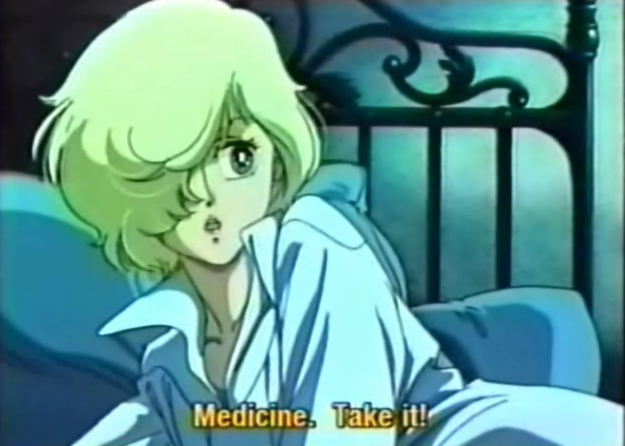
Who is this Gilbert Cocteau that Serge is literally waxing poetic about? He was his new roommate when he started school, and boy, does he have some issues. He more or less never goes to class, yet he continually gets good grades because he sleeps with other guys in exchange for his exams. And honestly, his personality is quite turbulent on its own. Of course, Serge doesn't have any indication that his new roommate is so tumultuous - I have to say, the OVA more or less beats you over the head with his relative optimism and innocence.
As soon as I saw that scene, I knew that something crazy was going to happen almost immediately, and hey, I was right. Gilbert storms in to the room, violently ill and in the throes of passion. Serge is quite taken aback, though he seems to be the only one on his floor who has any sort of reaction - that reaction intensifies when his floormate Pascal fills him in on what's going on. This all comes to a head when Jack Dren, one of Gilbert's jilted lovers, comes into their room at night, tries to strangle Serge to make him pass out in his bed...
...and then rapes Gilbert. It's an absolutely unpleasant scene, but it works - we aren't told anything of Jack and Gilbert's past, we see only the aftereffects. And those aftereffects make us question everything - what really is going on with Gilbert? Why is he drawn to these frankly homicidal men?
We aren't given any quick answers, but instead we're treated to a side of Serge we've never seen, and honestly were never expecting. Upon waking up from his impromptu strangulation, he fights with Jack until he flees the room, and then, even more unexpectedly, starts barking orders at Gilbert in an attempt to make him feel better.
Not only is his assertiveness completely new, but so is his attitude of care towards his new roommate. Obviously, we can understand that he's horrified by what's gone on, and we already know that he's a pretty good guy to begin with, but this all begs the question - is Serge, who up to this point was horrified by Gilbert's lifestyle, actually developing an attraction for him? That question comes up again and again, and even Serge's other classmates pick up on it, albeit in the most offensive and dismissive way possible.
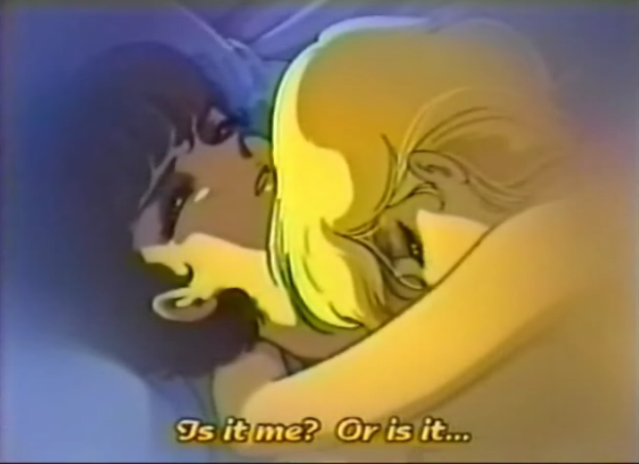
Though we aren't told explicitly, the impression that I got is that Serge has virtually no romantic or sexual experience whatsoever, so the struggles he has are that much more complicated. This gets even more complicated when, eventually, Gilbert seems to put the moves on Serge himself.
What does Gilbert see in Serge? Like so much else of Gilbert's past and inner thoughts, we aren't told, and again, it works - we want to watch more and find out what the hell is going on in this guy's head. But, sadly, at only an hour running time, it ends before it answers much of anything. Though, I'll be honest, it works surprisingly well here.
Kaze's story, though incomplete and leaving much for us to read in the manga, feels complete in itself. Perhaps the Kaze manga, in its 17 volumes, gives us the entire panoramic view of Serge and Gilbert's relationship, but the OVA gives us only the prelude to that relationship, and it's satisfied with that. It doesn't feel random or arbitrary - Yas was skilled enough as a director to pick one small part of the story and make that feel complete, and he did.
There is a lot left unsaid - we only know Gilbert on the surface, and we only know a tiny bit of his relationship with Auguste, which, from what we're seen, seems to be the determining factor in his violent life. We're given suggestions, though, and those suggestions help us at least come to some sort of understanding of his character. Granted, I was helped by the wonderful notes presented at the beginning, but I feel that even if I didn't have them, I would have understood, and enjoyed, this show just as much as I did.
I did very much enjoy this show, and I think anyone who enjoys tragic love stories or character dramas will get something out of it. It probably was written primarily for fans of the manga, though I think it was well done enough for even someone who hasn't heard of the manga to enjoy. I now very much want to read the manga, and can only hope the scanlation group actually does get around to finishing it - this story has too much potential to leave unfinished.
Like Power Rangers before it, I can't understate how important the Final Fantasy series has been in my development as the person I am today. I vividly remember the first time I saw one of my friends play Final Fantasy VII back in 1998 - this was my first encounter with any Role Playing Game, so I had literally never seen anything like it. The world was expansive, the story was epic and cinematic in scope, the music was unbelievable, and the graphics, silly as they may look today, completely blew me away.
Yeah, that's about right.
I could honestly write an entire post just about my history with the Final Fantasy series, and perhaps someday I would. But in the interest of keeping this simple, right now I'm just going to talk about my first impressions playing the newest entry in the series, Final Fantasy XV, which was released last Tuesday. I wanted to have this out a few days ago, but I've been playing it so much that I haven't had the time to write. Let that be an early indication as to how I feel about the game at this moment.
In the game, you play as Noctis, crown prince of the Kingdom of Lucis, and candidate for the worst haircut in the history of the human race. I refer to it as emo bitch boy hair.
Lucis is for lovers.
Anyway, Noctis and his entourage are on their way to Altissia, where he will marry Lady Lunafreya, Oracle and princess of the kingdom of Tenebrae. Things don't quite go as planned - the EVIL EMPIRE of Niflheim breaks their pact of nonaggression with Lucis and destroys the capital city of Insomnia, killing Noctis' father, king Regis. In the aftermath, Noctis and Lunafreya are pronounced dead by the empire. As the sole heir to the throne of Lucis, Noctis and his friends must both find Lunafreya and somehow restore peace to their homeland.That's the basic story in a nutshell.
Of course, since this is a role-playing game, there's a lot more going on than just the main plot. There are an incredible amount of side quests in this game, with many of them requiring detailed exploration of the game's world of Eos. This is not a bad thing - Eos is an incredibly detailed, beautifully designed world that, more than any other Final Fantasy world (VIII is probably the only other comparable one), feels like our own. Sure, there's kingdoms run by magic and giants sleeping in caves of fire, but there's also quaint forest villages and outposts settled in the middle of open fields, complete with colorful locals you can talk to. In a way, exploring Eos feels as though you're taking a road trip through the United States.
I saw road trip purposefully - one of the main things people talked about before this game even launched is the fact that you spend a lot of time driving around, in a very 21st Century looking car. I think some were turned off by that, which I found really dumb. First of all, you drove cars, and trains, in Final Fantasy VIII, and I've never heard anybody complain about that. And unlike Final Fantasy VIII, driving in this game is fun, if for no other reason than you can admire the architecture of the game's world.
Let's not talk anymore about the driving - let's discuss the characters instead. Noctis is the most fleshed out so far (of course) - he's a good guy, but being the prince of Lucis, he can come across as very privileged, especially when wandering around what may as well be Eos' version of southern Illinois. His privilege doesn't make him annoying, though, which I feel is hard to pull off. Now that his father is dead and he's effectively king of Lucis, he has to do a lot of growing up, very very quickly. Thankfully, he has his advisors, Ignis (the soft spoken smart guy) and Gladiolus (the tough talking bodyguard) and his friend Prompto, who reminds me of both Tidus and Zell from Final Fantasy X and VIII, to back him up. The four characters are built on fairly reliable character archetypes, but they work well and are effective when played against one another. We haven't gone too far in depth with the other three party members yet, and I'm looking forward to seeing where they come from.
Combat-wise, it's actually fairly similar to Kingdom Hearts, in that everything is in real time, you can only directly control one party member (Noctis, in this case) and it's chaotic as hell. Unlike Kingdom Hearts, thankfully, enemies don't fucking hit you a half a second before you heal yourself and kill you and make you have to fucking watch that cutscene with Riku for the five-hundredth time and...oh, maybe I'm getting off track. But anyway, it's a lot more manageable than Kingdom Hearts, and it gives you plenty of opportunities to retreat if you happen to walk into something that's too far above you.
Honestly, I don't really have too much to complain about (not that I feel bad about that). If anything, Final Fantasy XV has the same problem that similar modern RPGs, like Skyrim or Xenoblade Chronicles, has in their structure. There are so many side quests that the main story can be left by the wayside for hours upon hours - this can drastically reduce the tension provided by that main story. To be honest, I don't know how to fix that - though I will say that I found it more tolerable than Skyrim, since unlike that game, the main character isn't a complete blank slate.
I do have to take away some points for Noctis' hair, though. Anyone who thinks styling yourself like that is a good idea must be insane.
So yes, maybe this blog went on a bit longer than I wanted (it's a recurring trend), but that's what I feel about Final Fantasy XV. Honestly, it's my favorite entry in the series since X was released in 2001. I don't know if I'm alone in that - I don't read reviews for Final Fantasy games anymore, because ever since IX was released, the fanbase has been impossible to please completely, with every game getting mixed reviews. So just do yourself a favor and play it.